Every day, we glance at our smartphones, check train schedules, and plan our lives around precise time. Yet few of us ever stop to wonder where that accuracy comes from—or how it is maintained.
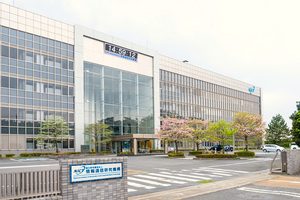
In Koganei, Tokyo, the National Institute of Information and Communications Technology (NICT) quietly safeguards Japan Standard Time, the invisible foundation that keeps everything from financial markets and communications to transportation and navigation running in sync. But how did this remarkable system come to shape the rhythm of modern Japan?
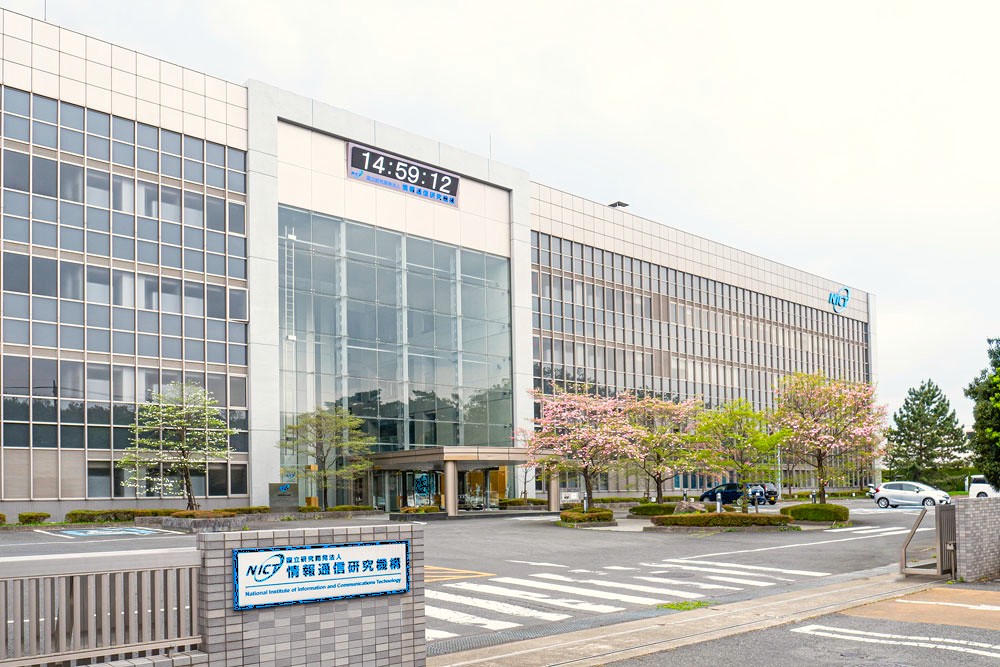
Photo courtesy of the National Institute of Information and Communications Technology (NICT).
NICT: The Institution Behind Japan Standard Time
The organization responsible for maintaining, managing, and disseminating Japan Standard Time (JST) is the National Institute of Information and Communications Technology (NICT).
NICT operates facilities throughout Japan, but its headquarters is located in Tokyo’s Tama region, spanning the cities of Koganei and Kodaira. Facilities related to Japan Standard Time are located in Nukui-Kitamachi, Koganei. The city of Koganei takes pride in being home to NICT, the institution responsible for Japan’s standard time, and the city government and other local organizations sometimes highlight this connection. NICT also collaborates with local organizations on public events and other activities.
To keep Japan Standard Time at the highest international level, NICT does more than simply maintain and manage the country’s official time. It also conducts advanced research and development into highly precise atomic clocks and techniques for comparing time internationally with extraordinary accuracy.
I joined the Communications Research Laboratory (CRL), one of NICT’s predecessor organizations, in 1990. In 1994, I transferred to the Space-Time Measurement Laboratory in the Standards and Measurement Department. I subsequently worked in areas including the Frequency Standards Division and the Atomic Standards Laboratory, becoming involved in research on Japan Standard Time and the measurement of time and space in various capacities. I am now retired from the organization and work as a visiting researcher.
When I joined in the early 1990s, the best atomic clocks had reached what was known as 13-digit precision—an uncertainty equivalent to roughly one second in 300,000 years. Since then, almost without my realizing it, the precision of atomic clocks, and of Japan Standard Time itself, has improved dramatically, advancing through 14 and 15 digits and eventually to 16 digits.
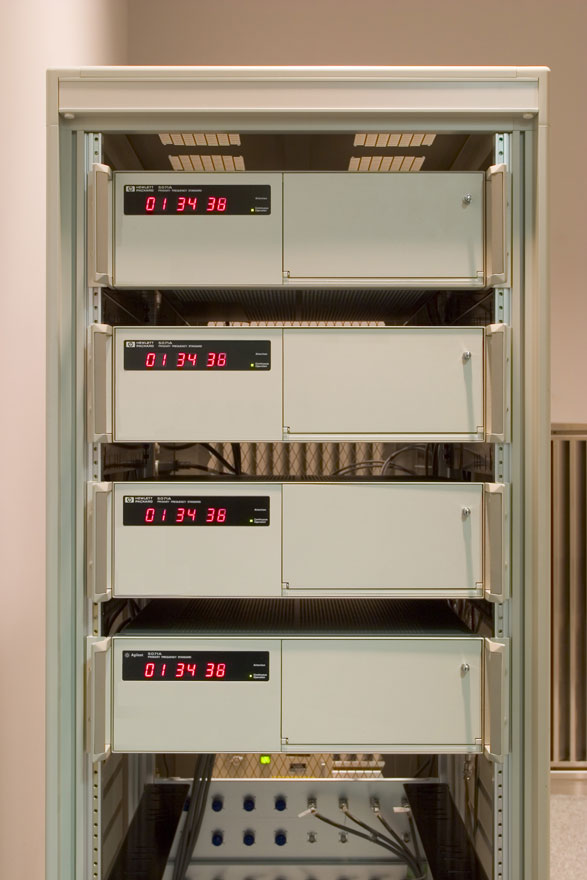
A cesium atomic clock at NICT Headquarters, one of more than 20 atomic clocks used to generate Japan Standard Time and based on the same principle as the international definition of one second.
Courtesy of the National Institute of Information and Communications Technology (NICT)
There are many technological reasons for this remarkable improvement, but one of the most important was the development of laser technology and its application to atomic clocks.
An atomic clock works by exposing atoms to electromagnetic waves and identifying the frequency at which a particular quantum transition—known as the “clock transition”—occurs. That frequency serves as the clock’s fundamental reference, much like the pendulum in a conventional mechanical clock.
Until the early 1990s, atomic clocks used magnets to select, from a large number of atoms, only those in the quantum state required for the clock transition. The remaining atoms were simply discarded.
The development of laser technology changed this approach. Researchers became able to manipulate the quantum states of atoms with great precision, making it possible to prepare essentially all of the atoms in the state required for the clock transition.
Atomic clocks using this technique are known as optically pumped atomic clocks. Because they make more efficient use of the available atoms, they improve the signal-to-noise ratio (S/N ratio), reducing one of the sources of measurement uncertainty and thereby improving the clock’s precision. The technology began to see practical application in the first half of the 1990s, making 15-digit precision possible.
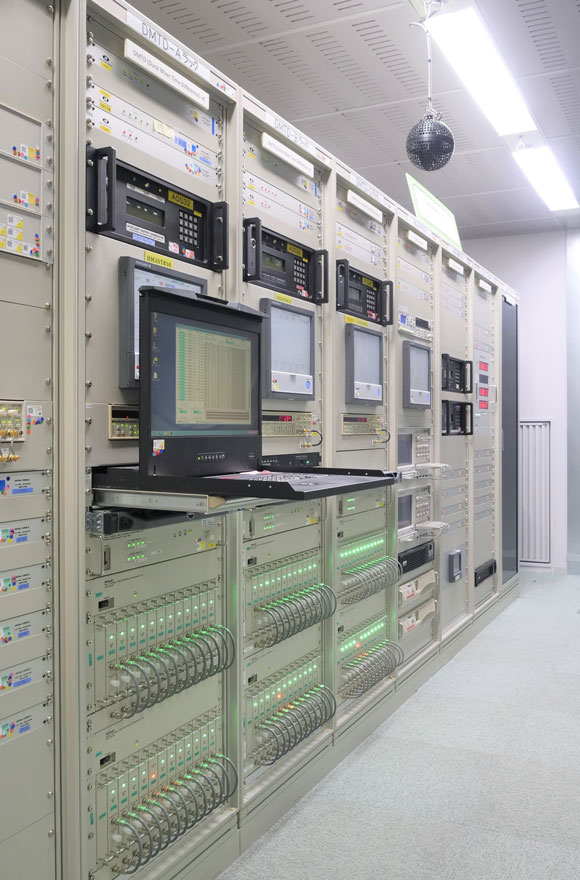
At NICT Headquarters, Japan Standard Time is generated by combining multiple atomic clocks and other technologies, and the precise time is distributed via standard time signals and the internet to support daily life, communications, and social infrastructure.
Courtesy of the National Institute of Information and Communications Technology (NICT)
Another breakthrough came with the development of laser cooling, which uses lasers to remove heat from atoms and slow their motion to almost a standstill.
Instead of exposing rapidly moving, thermally excited atoms to radio waves, researchers could cool the atoms and launch them slowly upward, much like water rising from an artificial fountain, and measure them as they moved. This approach led to the development of atomic fountain clocks, which achieved 16-digit precision. Practical operation appears to have begun around the late 1990s.
At the time, research institutions in the United States, Germany, France, and elsewhere were leading the world in these technologies. At NICT’s Atomic Standards Laboratory—then part of the Communications Research Laboratory—we worked together with a shared determination to “catch up with the rest of the world,” devoting ourselves to both research and the practical operation of these technologies. I still remember those days vividly.
Since then, the field has advanced even further, with newer technologies such as optical lattice clocks emerging.
The latest developments in Japan Standard Time and the current system supporting it would be best described by researchers working in the field today. In this article, however, I would like to share some of my own experiences from many years of working on Japan Standard Time and space-time standards, along with stories I heard from senior researchers who came before me.
The Standard Time Signal Was Once Broadcast from Koganei
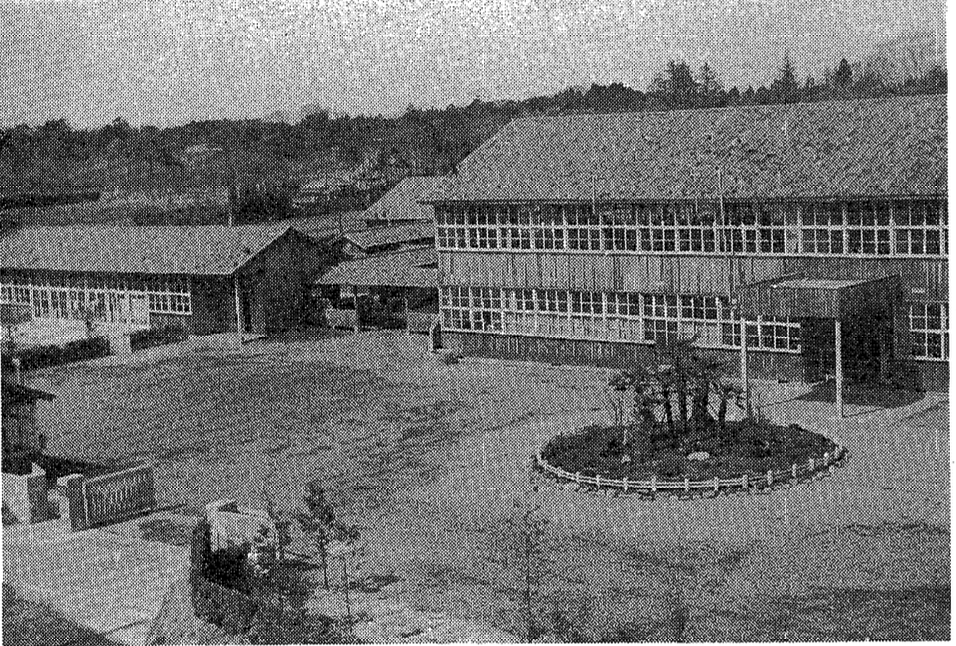
From The 50-Year History of the Standard Frequency Signal
The Radio Research Laboratory, the predecessor of the Communications Research Laboratory (CRL) where I began my career, originally had the task of providing frequency standards for wireless communications. Its principal means of doing so was the transmission of what was known as a standard frequency signal.
The service dates back even further, to 1940, when it was launched by Japan’s Ministry of Communications. After World War II, the service was inherited by the newly reorganized Radio Research Laboratory and eventually passed on to NICT, where it continues today.
Over time, the standard signal came to carry not only a reference frequency but also information about Japan Standard Time. The history of how this came about is rather complicated, however, so I will leave that story for another occasion.
The standard time signal has been transmitted continuously since 1940. More than a decade of testing was carried out before the service officially began, and apparently the system initially used a foreign-made quartz oscillator as its reference.
The first transmitting station was established in Kemigawa, Chiba Prefecture, in what is now part of Chiba City. As research and development progressed, efforts were made to transmit time information with greater accuracy. In August 1948, the transmission of standard time information via the standard frequency signal also began.
To improve the accuracy of this time signal, the transmitting facilities were moved to Koganei, closer to the Tokyo Astronomical Observatory in Mitaka, which at the time was responsible for determining Japan’s standard time. The relocation from Kemigawa was completed in 1949.
Although the new site was in Koganei, it was not at today’s NICT headquarters in Nukui-Kitamachi, at the western edge of the city. Instead, it was located farther east.
The Frequency Standards Station, which handled the generation and control of the standard signal, position management, and related research and development, was established in Midoricho, on the site now occupied by Tokyo Metropolitan Koganei-Kita High School. The transmitting station, with its antenna, was located in neighboring Kajinocho.
In August 1952, these facilities and their operations were transferred to the Radio Research Laboratory of the Ministry of Posts and Telecommunications, which had been established as part of a government reorganization.
In other words, Koganei was not merely home to the institution responsible for maintaining and managing Japan Standard Time. It was also the place where frequency standards were maintained and where standard frequency signals carrying Japan Standard Time information were once transmitted.
At the time of the relocation, Koganei was not yet a city. It was still Koganei Town in Kitatama District, Tokyo, and its population was relatively small. I have heard that there were few obstacles to operating a powerful radio transmitter in such an environment.
Koganei became a city in 1958. As the population grew rapidly during Japan’s period of high economic growth, more houses began to appear around the transmitting station by the mid-1960s. Television and radio reception problems then began to occur, and discussions turned toward relocating the station to a new site.
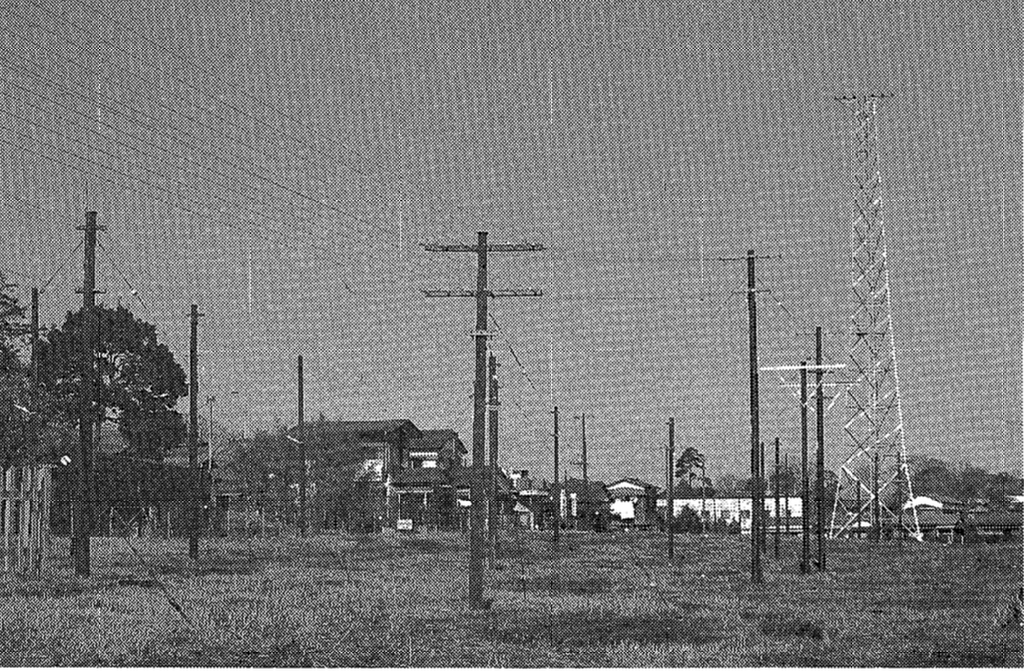
From The 50-Year History of the Standard Frequency Signal
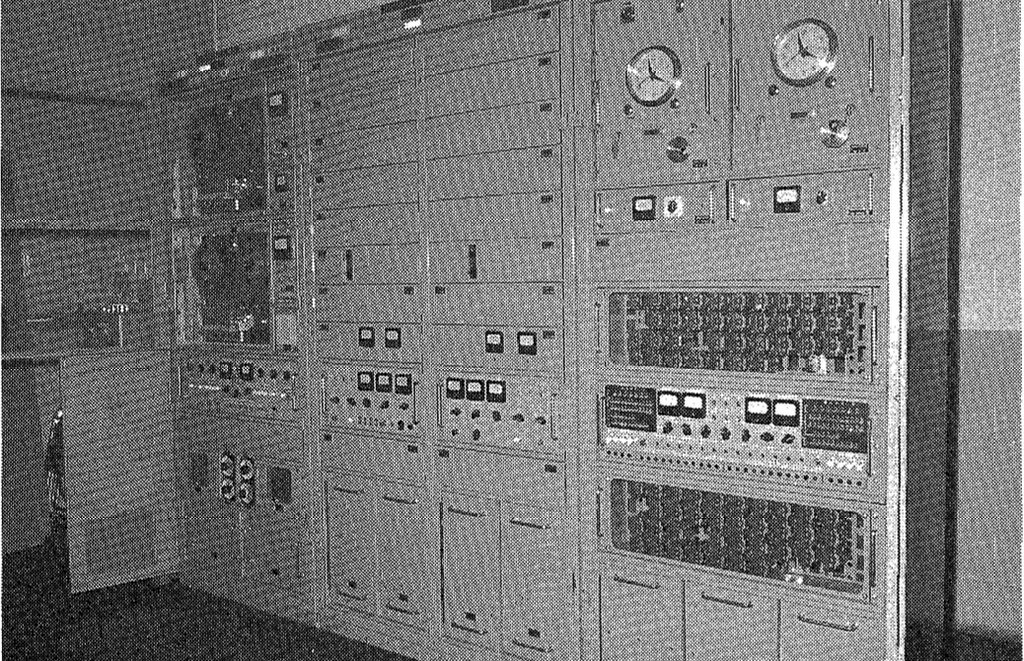
The control equipment used to transmit standard frequency signals carrying precise time information, photographed in 1964.
From The 50-Year History of the Standard Frequency Signal
The Research Institute in the Midoricho Era
After years of discussion and preparation, the standard frequency transmitting station was finally relocated and began operating at its new site in December 1977.
Until the relocation, the Midoricho site housed not only the standard frequency transmitting station but also the Frequency Standards Department, which included laboratories developing atomic frequency standards and conducting research into time and frequency measurement. The Standard Frequency Division within the department was responsible for operating the standard signal.
However, before the transmitting station itself was moved, the entire Frequency Standards Department was relocated to the main NICT site in Nukui-Kitamachi. That relocation was completed in 1975.
When I joined the Communications Research Laboratory in 1990, many senior colleagues who had worked during the Midoricho era were still there. I had the opportunity to hear some of their stories about what life had been like at the old research institute.
There had been a considerable number of employees, and even softball tournaments were held between different sections.
The standard frequency signal was transmitted on several different frequencies. At first, the signals were broadcast only during certain hours, but from the mid-1950s onward, an increasing number of frequencies were operated around the clock in accordance with regulations.
Naturally, this meant that some of the staff responsible for operating the standard frequency service had to work night shifts, giving them time off during the day.
The Midoricho site even had a tennis court and a recreation room, and many employees apparently spent their free time playing tennis or Go. That culture continued after the move to Nukui-Kitamachi, and when I joined the organization, many of my senior colleagues were still remarkably skilled at both tennis and Go.
Of course, operating a national service as important as the standard frequency transmission came with enormous responsibility. If something went wrong, the consequences could be serious. I experienced this myself on several occasions.
At the same time, when everything was running smoothly, there seems to have been a surprisingly peaceful, almost idyllic side to everyday life there.
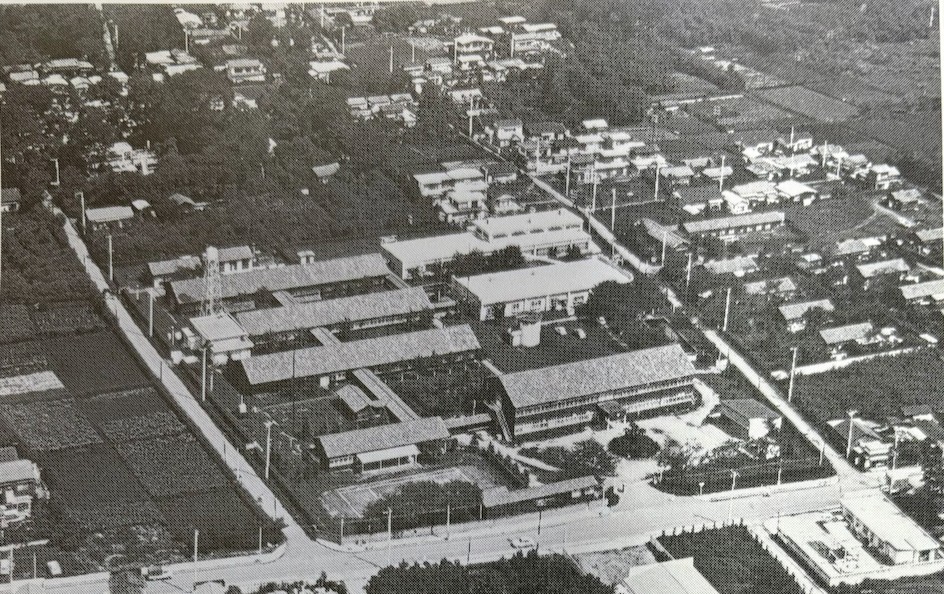
From The 50-Year History of the Standard Frequency Signal
The Nasaki Transmitting Station and the Y2K Problem
The new transmitting site chosen after the standard frequency station left Midoricho, Koganei, was the Nasaki Radio Transmitting Station in what is now Koga City, Ibaraki Prefecture. At the time, the area was part of Sashima District’s Sanwa Town, and the station was operated by Nippon Telegraph and Telephone Public Corporation, commonly known as Denden Kosha.
At Midoricho, staff from the Frequency Standards Department directly managed and operated the transmitting station. At Nasaki, however, the transmission work was outsourced to Denden Kosha, while the management and control of the standard frequency signal were carried out remotely from the main facility in Koganei. The station itself therefore operated as an unmanned facility.
I visited the Nasaki transmitting station several times on official business. It was an enormous communications facility operating radio transmission equipment for numerous government agencies, news organizations, and other users. The equipment for the standard frequency signal occupied only a small part of the site.
I was surprised to learn that Nasaki also became one of the settings for the 1996 film Gamera 2: Attack of Legion.
But what I remember most vividly about Nasaki is something else entirely.
It was there that I spent New Year’s Eve 1999 as the world anxiously awaited the arrival of the year 2000 and the possible digital-system failures associated with the Y2K problem, also known as the Year 2000 computer problem.
At the time, there was widespread concern around the world that computers might malfunction when the calendar changed to the year 2000, potentially disrupting critical infrastructure.
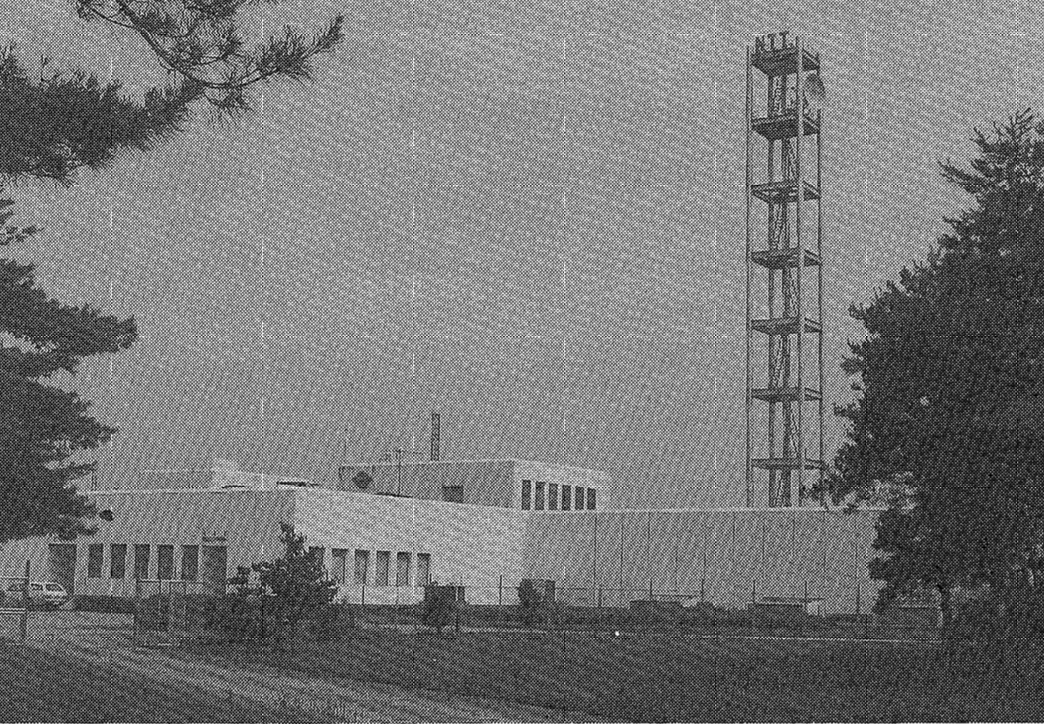
The standard frequency transmitting equipment installed at the Nasaki Radio Transmitting Station in Ibaraki Prefecture after its relocation from Koganei in 1977.
From The 50-Year History of the Standard Frequency Signal
Because any problem with Japan Standard Time or the standard frequency signal could have significant consequences for society, the Frequency Standards Division, which was responsible for both at the time, went on heightened alert.
I was then a member of the division and was assigned, together with a colleague, to spend New Year’s Eve at the Nasaki transmitting station.
On the evening of December 31, 1999, we got off at JR Koga Station, rented a car, bought enough food and other supplies to spend the night there, and headed for Nasaki.
The reason for our presence was simple: if something went wrong with the system, we needed to be able to manually shut down the transmitting equipment and prevent an incorrect standard signal from being broadcast.
The normally unmanned standard frequency station had only a small black-and-white television, apparently an added convenience to equipment used for monitoring television signals.
My colleague and I watched the annual NHK Kohaku Uta Gassen music show on that tiny television as midnight approached.
When the clock struck midnight and the year 2000 arrived, nothing happened. We breathed a sigh of relief.
We then went to sleep on a long bench at the station.
The next critical moment came at 9 a.m. the following morning: midnight on January 1, 2000, in Coordinated Universal Time (UTC), the world’s reference time.
Once again, nothing went wrong. The system continued operating normally.
At last, we could relax. We packed up the things we had brought with us, left the transmitting station, and returned home by train on New Year’s Day.
In the end, the Y2K problem caused no trouble for the standard frequency system. Nevertheless, spending that first night of the year 2000 far from home, watching the clock with a mixture of tension and anticipation, remains one of my most unforgettable memories.
From Shortwave to Longwave: The Evolution of the Standard Time Signal
From Kemigawa to Nasaki, Japan’s standard frequency signals were transmitted entirely on shortwave frequencies, including 5 MHz and 10 MHz.
Shortwave has the advantage of traveling long distances because radio waves can be reflected by the ionosphere, allowing signals to be received over a wide area. At the same time, however, the way shortwave propagates varies with conditions in the ionosphere. This presented a challenge for a service whose purpose was to deliver stable and reliable time information.
Eventually, the standard frequency service shifted to longwave frequencies of 40 kHz and 60 kHz, whose signals propagate primarily along the Earth’s surface rather than relying on reflection from the ionosphere.
Transmission of the standard frequency signal from Nasaki ended on March 31, 2001.
There is a much longer story behind this transition, so I will save the details for another occasion.
The standard frequency signal is also known by the name JJY. This is the call sign used to identify the facility transmitting the radio signal, and it has been used continuously from the shortwave era through today’s longwave standard frequency service.
JJY has also become a symbolic presence associated with the standard frequency signal that delivers Japan’s precise time.
Today, NICT’s headquarters in Nukui-Kitamachi, Koganei, Tokyo, has a public exhibition room introducing the organization’s work and research in information and communications technology.
The exhibition also includes displays on the standard frequency signal and Japan Standard Time, making it well worth a visit for anyone interested in the history and science of time.
The exhibition room is open on weekdays from 9:30 a.m. to 5:00 p.m., with admission accepted until 4:30 p.m. Admission is free. Advance reservations are currently required, although same-day visits may be possible depending on availability. Please check the NICT Headquarters Exhibition Room information for details.
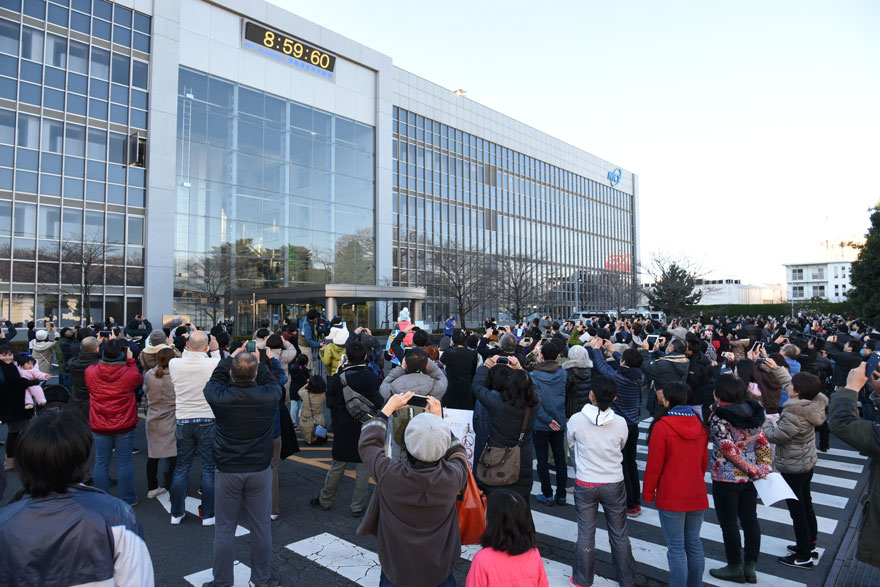
Courtesy of the National Institute of Information and Communications Technology (NICT)
References
The 50-Year History of the Standard Frequency Signal, Standards and Measurement Department, Communications Research Laboratory, Ministry of Posts and Telecommunications, March 1991.
Featured Location
National Institute of Information and Communications Technology (NICT) Headquarters
The National Institute of Information and Communications Technology (NICT) maintains Japan Standard Time and provides accurate time to society. At its headquarters in Koganei, Tokyo, visitors can learn about research related to Japan Standard Time and view exhibits on its history and technology.
Address
4-2-1 Nukui-Kitamachi, Koganei, Tokyo 184-8795, Japan
Access
About 10 minutes by bus from either Musashi-Koganei or Kokubunji Station on the JR Chuo Line. Get off at the NICT-mae bus stop and walk about 2 minutes.
Visitor Information
The NICT Headquarters Exhibition Room introduces Japan Standard Time, along with NICT’s research achievements and historical materials. Admission is free. Advance reservations are required.
https://www2.nict.go.jp/publicity/exhibition/exhibition_room/hq/index.html
About the Author

Mizuhiko Hosokawa
Senior Visiting Researcher, NICT Knowledge Hub
Hosokawa completed his doctoral studies at the Graduate School of Science, Tohoku University, in 1988. In 1990, he joined the Communications Research Laboratory of the Ministry of Posts and Telecommunications, now NICT. Since then, he has worked on relativistic effects in precision space-time measurement, the maintenance and management of Japan Standard Time, and the development of atomic clocks.
From 2008 to 2011, he served as Chair of the Technical Committee on Time and Frequency at the Asia-Pacific Metrology Programme. From 2012 to 2015, he served as Chair of the International Astronomical Union’s Commission on Time.
He became an Executive Director of NICT in 2016, was appointed Principal Researcher in 2021, and assumed his current position in 2026.
His co-authored books include The Positions and Motions of Celestial Bodies (Nippon Hyoron Sha) and A History of Time in Japan (Shogakukan).
He chose to pursue a career in research after studying physics out of a desire to understand the fundamental principles underlying the world and the universe.